Episode
Why Hamsters Stuff Their Cheeks
Why does your hamster stuff his cheeks and hide the food? Pip does it every night; his wild cousin fills an underground pantry for winter.
Updated
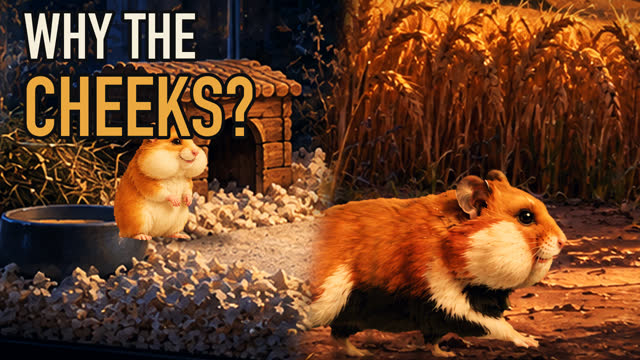
Wild Cousins · Episode 3 · 15:35. Long-form episode; the video player arrives at public launch.
What the episode is about
Pip, a golden hamster, stuffs his cheeks until his face is twice the size, then hides the food. In a wheat field in central Europe, the wild European hamster fills an underground larder for winter. We follow both to see why hamsters hoard.
Key facts
- Hamster cheek pouches reach back toward the shoulders.
- Most pet golden hamsters trace back to a small colony founded in 1930; wild golden hamsters are listed as Endangered.
- The European hamster is listed as Critically Endangered (IUCN, 2020).
Why does my pet...?
Scenes are painted and dramatized from the sources below. Where accounts disagree, the episode says so.
More from Wild Cousins
- Why Your Cat Goes Wild at 3 A.M.
- Why Dogs Spin Before Lying Down
- Your Dog vs a Wolf: Who Has the Better Nose?
Sources
- Pet golden hamsters mostly nocturnal; wild golden hamsters (Syria) day-active; most pet lines trace to a small colony founded in 1930: Gattermann et al. (2008), Golden hamsters are nocturnal in captivity but diurnal in nature, Biology Lette
- Wild golden hamster range (northern Syria, southern Turkey), solitary burrows with a nest chamber and a food chamber: Gattermann et al. (2001), Notes on the current distribution and the ecology of wild golden hamsters, Journal of Zoology
- Wild golden hamster: Endangered (IUCN): IUCN Red List, Mesocricetus auratus
- Cheek pouches reach toward the shoulders; pet golden hamster basics: Merck Veterinary Manual, Hamsters; RSPCA, Hamsters
- Hamster senses and care basics: RSPCA, Hamsters
- European hamster (Cricetus cricetus): description, habitat, burrows, diet, hibernation, status Critically Endangered (2020), decline causes: IUCN Red List, Cricetus cricetus (Banaszek et al. 2020)
- European hamster biology: burrow structure, larders, hibernation and arousals, emergence, threat display (secondary summary of the field literature): European hamster, Wikipedia (summarising Kayser, Weinhold & Stubbe and Wassmer hibernation
- Conservation: breeding and release programmes such as Alsace, France; farmland measures: European hamster, Wikipedia, Conservation section; IUCN Red List assessment
- German 'hamstern' = to hoard: Duden / DWDS
This is general information, not veterinary advice. If anything about your pet's behavior or health worries you, ask your vet.