Episode
Why Your Cat Goes Wild at 3 A.M.
Why does your cat get the zoomies at night? Meet Miso and her wild double, the black-footed cat, one of the most successful hunters among cats.
Updated
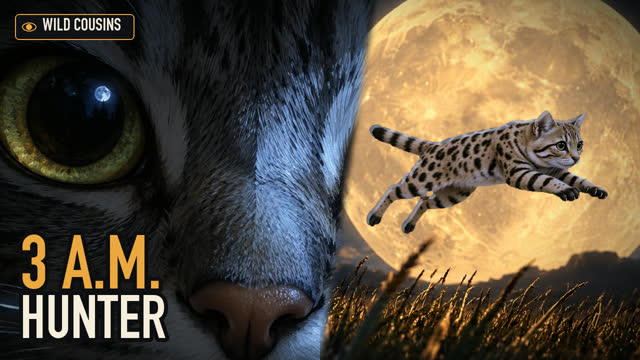
Wild Cousins · Episode 1 · 12:05. Long-form episode; the video player arrives at public launch.
What the episode is about
Miso, an indoor cat and professional napper, races the hallway at three in the morning. Far away in southern Africa, the black-footed cat, the continent's smallest wild cat, starts its own night of hunting. We follow both and find out what Miso's body still remembers.
Key facts
- Cats are most active around dusk and dawn (crepuscular).
- A reflective layer behind the eye, the tapetum lucidum, makes cats' eyes shine in the dark.
- Pet cats descend from the Near Eastern wildcat; domestication began about 10,000 years ago (Driscoll et al., 2007).
Why does my pet...?
- Why does my cat get the zoomies at night?
- Why does my cat hunt even when she's well fed?
- Why do my cat's eyes glow in the dark?
Scenes are painted and dramatized from the sources below. Where accounts disagree, the episode says so.
More from Wild Cousins
- Why Dogs Spin Before Lying Down
- Why Hamsters Stuff Their Cheeks
- Your Dog vs a Wolf: Who Has the Better Nose?
Sources
- Zoomies = frenetic random activity periods; stored-up energy; indoor cats; dusk/dawn; when to see a vet: PetMD, "Why Do Cats Get Zoomies?" (Dr. Elizabeth Stelow, UC Davis; Dr. Alison Gerken, SF SPCA)
- Cats are crepuscular (most active at dusk and dawn): Tufts Catnip
- Cats hear far above the human range: Heffner & Heffner (1985), Hearing range of the domestic cat, Hearing Research 19: 85-88
- Tapetum lucidum and eyeshine: The Conversation via WGBH, "Why do cats' eyes glow in the dark?"
- Cats leave their food to hunt, then return to the meal: Adamec (1976), Behavioral Biology 18: 263-272; summary: WikiVet, Feline Predatory Behaviour
- Pet cats descend from the Near Eastern wildcat; domestication began in the Near East ~10,000 years ago: Driscoll et al. (2007), Science 317: 519-523
- Cat buried with a person on Cyprus ~9,500 years ago: Vigne et al. (2004), Science 304: 259
- Black-footed cat: size, range (South Africa, Namibia, Botswana), day dens (98% springhare burrows), "anthill tiger", hairy black soles, activity around sunset/sunrise, diet (72% mammals), leaps, water from prey, home ranges, kittens' alarm-
- Three hunting styles; ~70% of the night hunting; 4.5-16 km (avg 8.5 km) a night; 10-14 catches a night; big prey cached up to three nights: Wild Cat Conservation, Black-footed cat hunting & diet
- Up to 60% hunting success; 10-14 kills a night, ~1 every 50 min: Guinness World Records, Most successful feline predator (Olbricht & Sliwa, International Zoo Yearbook 1997)
- Comparison with lions' hunting success: Live Science, quoting Panthera's Dr. Luke Hunter
- Conservation status: Vulnerable: IUCN Red List, Felis nigripes (Sliwa et al. 2016)
- Play like prey, let your cat catch the toy, end with a treat or meal: Ontario SPCA, What is interactive play for cats?
- Put wand/string toys away after play: Bide-A-Wee, How to properly play with your cat
- Enrichment: cat trees, scratchers, treat dispensers: PetMD (above)
This is general information, not veterinary advice. If anything about your pet's behavior or health worries you, ask your vet.