Episode
Your Dog vs a Wolf: Who Has the Better Nose?
Why does your dog stop at every lamp post? Follow Juno on a morning walk, inside her nose, and out to her wild cousin, the grey wolf.
Updated
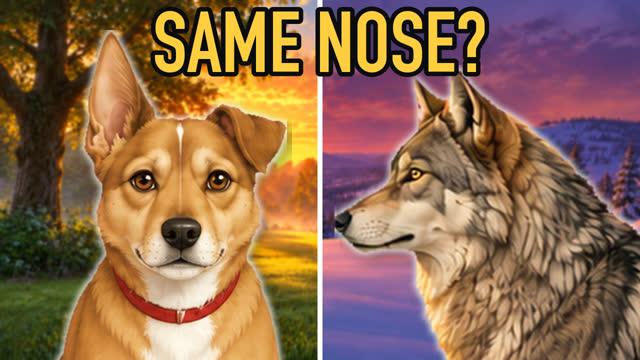
Wild Cousins · Episode 4 · 15:29. Long-form episode; the video player arrives at public launch.
What the episode is about
Juno, a rescue dog with one floppy ear, turns an ordinary morning walk into a reading session. We go inside a dog's nose, see the park the way a dog might, and travel to the snow to watch grey wolves scent-mark their territory.
Key facts
- A dog's nose sends some air to a separate smelling region, so sniffing is not the same as breathing (Craven et al., 2010).
- Trained dogs worked out which way a trail went from about five footsteps (Hepper & Wells, 2005).
- In one study, dogs given nosework sessions made more optimistic choices afterward (Duranton & Horowitz, 2019).
Why does my pet...?
Further reading
- Bekoff, M. (2001). Observations of scent-marking and discriminating self from others by a domestic dog: tales of displaced yellow snow. Behavioural Processes 55.
- Horowitz, A. (2017). Smelling themselves: dogs investigate their own odours longer when modified in an "olfactory mirror" test. Behavioural Processes 143.
- Peters, R. P. & Mech, L. D. (1975). Scent-marking in wolves. American Scientist 63(6).
- Dog domestication (at least ~15,000 years; place and timing debated): Frantz, L. A. F. et al. (2016) Science 352; Bergström, A. et al. (2020) Science 370.
Scenes are painted and dramatized from the sources below. Where accounts disagree, the episode says so.
More from Wild Cousins
Sources
- Hepper, P. G. & Wells, D. L. (2005). How many footsteps do dogs need to determine the direction of an odour trail? Chemical Senses 30(4).
- Craven, B. A., Paterson, E. G. & Settles, G. S. (2010). The fluid dynamics of canine olfaction: unique nasal airflow patterns as an explanation of macrosmia. J. R. Soc. Interface.
- Settles, G. S. et al. (2003). The external aerodynamics of canine olfaction.
- Staymates, M. E. et al. (2016). Biomimetic sniffing improves the detection performance of a 3D printed nose of a dog. Scientific Reports.
- Duranton, C. & Horowitz, A. (2019). Let me sniff! Nosework induces positive judgment bias in pet dogs. Applied Animal Behaviour Science.
- McGann, J. P. (2017). Poor human olfaction is a 19th-century myth. Science.
- AKC, smell-cell estimates and scent work
- VCA Animal Hospitals, How dogs use smell to perceive the world (vomeronasal organ)
- Siniscalchi, M. et al. (2018). Communication in dogs. Animals 8(8):131.
- Neitz, J., Geist, T. & Jacobs, G. H. (1989). Color vision in the dog. Visual Neuroscience.
- Miller, P. E. & Murphy, C. J. (1995). Vision in dogs. JAVMA. · Lind, O. et al. (2017). High visual acuity revealed in dogs.
- National Park Service, Wolf ecology in Yellowstone
- VCA, Anal sac disease in dogs (anatomy)
This is general information, not veterinary advice. If anything about your pet's behavior or health worries you, ask your vet.