Episode
Why Dogs Spin Before Lying Down
Why does your dog turn in a circle before lying down? Juno does it every night; a Yellowstone wolf does almost the same in deep snow.
Updated
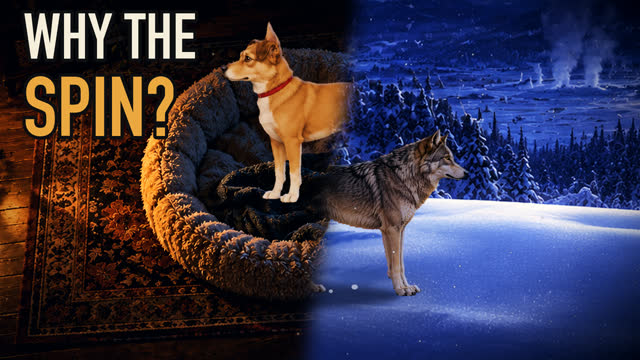
Wild Cousins · Episode 2 · 15:32. Long-form episode; the video player arrives at public launch.
What the episode is about
Juno, a rescue dog, turns in a circle every night before she settles. In Yellowstone, a wild grey wolf does almost the same thing in deep snow on a bitterly cold night. We follow both, from a cosy living room to a blizzard, to see what that little spin might be for.
Key facts
- Nobody is certain why dogs circle; proposed ideas include making the bed, a last safety check and settling into a curl.
- A tight curl can conserve heat; stretching out flat can help a dog lose heat.
- A wild wolf pack is usually a family, not a fight for "alpha" (Mech, 1999).
Why does my pet...?
Scenes are painted and dramatized from the sources below. Where accounts disagree, the episode says so.
More from Wild Cousins
- Why Your Cat Goes Wild at 3 A.M.
- Why Hamsters Stuff Their Cheeks
- Your Dog vs a Wolf: Who Has the Better Nose?
Sources
- Why dogs circle before lying down: no settled explanation; proposed reasons; Coren's small uneven- vs flat-carpet test (2016): Coren, S. (2016), Why do dogs turn in circles before lying down?, Psychology Today
- Proposed reasons for circling; when to ask a vet: VCA Animal Hospitals, Why dogs turn around before lying down
- Sweat glands in dog paw pads: Merck Veterinary Manual, The integumentary system in animals
- Dogs descend from ancient grey wolves; dogs present by at least ~15,000 years ago; origin still debated: Bergström et al. (2022), Grey wolf genomic history reveals a dual ancestry of dogs, Nature 607: 313-320; Bergström et al. (2020), Origi
- Yellowstone winter temperatures and snow: National Park Service, Yellowstone weather
- Wolves removed by 1926, reintroduced from Canada in 1995: National Park Service, Wolf management history
- Yellowstone wolf sizes; Lamar Valley wolf watching: National Park Service, Wolves in Yellowstone
- Packs are usually families; the 'alpha' picture came from unrelated captive wolves: Mech, L. D. (1999), Alpha status, dominance, and division of labor in wolf packs, Canadian Journal of Zoology 77: 1196-1203
- Travel in single file in deep snow; hunting; days between meals; dens as nurseries; pups; coat; howling: International Wolf Center, Wolf biology and behavior
- Ravens preferentially associate with wolves in winter: Stahler, Heinrich & Smith (2002), Common ravens preferentially associate with grey wolves as a foraging strategy in winter, Animal Behaviour 64: 283-290
- Winter coat, curled resting posture, snow resting on a wolf's coat: Wolf Science Center, The winter is coming
- Fresh snow is mostly air and insulates: National Snow and Ice Data Center, Why snow matters
- Arctic foxes wrap their tails around body and face: Alaska Department of Fish and Game, wildlife news
- Wolves and arctic foxes keep foot pads just above tissue freezing: Henshaw, Underwood & Casey (1972), Peripheral thermoregulation: foot temperature in two arctic canines, Science 175: 988-990
- Countercurrent vessels in dog paw pads: Ninomiya et al. (2011), Functional anatomy of the footpad vasculature of dogs, Veterinary Dermatology 22: 475-481
- Dogs align north-south when defecating under calm magnetic conditions: Hart et al. (2013), Dogs are sensitive to small variations of the Earth's magnetic field, Frontiers in Zoology 10: 80
This is general information, not veterinary advice. If anything about your pet's behavior or health worries you, ask your vet.