Episode
Why Lizards Wait for the Sun
Why would a lizard wait all morning for the sun? Ziggy the bearded dragon warms up while an old garden wall wakes up outside.
Updated
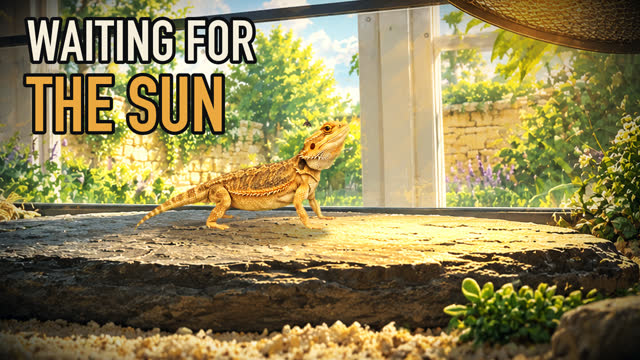
Backyard Giants · Episode 3 · 17:21. Long-form episode; the video player arrives at public launch.
What the episode is about
Ziggy, a bearded dragon, warms up under his lamp while, outside the window, an old stone wall comes alive: a wall lizard creeps out to bask, a zebra jumping spider stalks the sill, and black garden ants farm aphids at the foot of the wall.
Key facts
- Lizards are ectotherms: they borrow heat from their surroundings.
- Wild bearded dragons are darker when cool and lighter when warm (Smith et al., 2016).
- Never grab a lizard by its tail.
Why does my pet...?
Scenes are painted and dramatized from the sources below. Where accounts disagree, the episode says so.
More from Backyard Giants
- Your Hamster's Garden at Night: Moths, Spiders, Hedgehogs
- Why a Rabbit Fears the Sky: Hawks, Kestrels and Buzzards
Sources
- Central bearded dragon: range, habitat, behaviour, diet: Australian Museum, Central Bearded Dragon
- Bearded dragons change colour with temperature in the wild (darker when cool): Smith et al. (2016), Color change for thermoregulation versus camouflage in free-ranging lizards, The American Naturalist 188: 668-678
- Thermal gaping in bearded dragons: Tattersall & Gerlach (2005), Hypoxia progressively lowers thermal gaping thresholds in bearded dragons, Journal of Experimental Biology 208: 3321-3330
- Bearded dragon displays (head bob, arm wave, beard) and basking: Brattstrom (1971), Social and thermoregulatory behavior of the bearded dragon, Copeia 1971: 484-497
- Parietal (third) eye: Encyclopaedia Britannica, Parietal eye
- Reptile thermoregulation: Huey (1982), Temperature, physiology, and the ecology of reptiles, Biology of the Reptilia 12
- Common wall lizard: range and habitat: IUCN Red List, Podarcis muralis
- Wall lizards in Cincinnati (c. 1951 release, 'Lazarus lizards'): Deichsel & Gist (2001), On the origin of the common wall lizards Podarcis muralis in Cincinnati, Ohio, Herpetological Review 32: 230
- Tail autotomy and regeneration in lizards: Bateman & Fleming (2009), To cut a long tail short: a review of lizard caudal autotomy studies, Journal of Zoology 277: 1-14
- What pet cats bring home in Britain (incl. reptiles): Woods, McDonald & Harris (2003), Predation of wildlife by domestic cats Felis catus in Great Britain, Mammal Review 33: 174-188
- Jumping spider eyes and movable retinas: Land (1969), Structure of the retinae of the principal eyes of jumping spiders, Journal of Experimental Biology 51: 443-470
- Depth perception from image defocus in a jumping spider: Nagata et al. (2012), Science 335: 469-471
- Hydraulic leg extension in jumping spiders: Parry & Brown (1959), The jumping mechanism of salticid spiders, Journal of Experimental Biology 36: 654-664
- Jumping spiders respond to prey on video: Clark & Uetz (1990), Video image recognition by the jumping spider Maevia inclemens, Animal Behaviour 40: 884-890
- Black garden ant queen longevity (lab record ~28.75 years): Hölldobler & Wilson (1990), The Ants (Kutter & Stumper 1969)
- Flying ant day spread across weeks (citizen science): Hart et al. (2018), Spatial and temporal variation in the flying ant phenomenon, Ecological Entomology
- Western fence lizard blood and Lyme disease bacteria: Lane & Quistad (1998), Borreliacidal factor in the blood of the western fence lizard, Journal of Parasitology 84: 29-34
- Green anole: Smithsonian's National Zoo, Green anole
- Mediterranean house gecko in the US: USGS Nonindigenous Aquatic Species, Hemidactylus turcicus
- Gecko adhesion (setae): Autumn et al. (2000), Adhesive force of a single gecko foot-hair, Nature 405: 681-685
This is general information, not veterinary advice. If anything about your pet's behavior or health worries you, ask your vet.