Episode
Your Hamster's Garden at Night: Moths, Spiders, Hedgehogs
What happens in the garden after dark? Pip watches from the window while we drop to hamster height to meet a moth, a bat, a spider and a hedgehog.
Updated
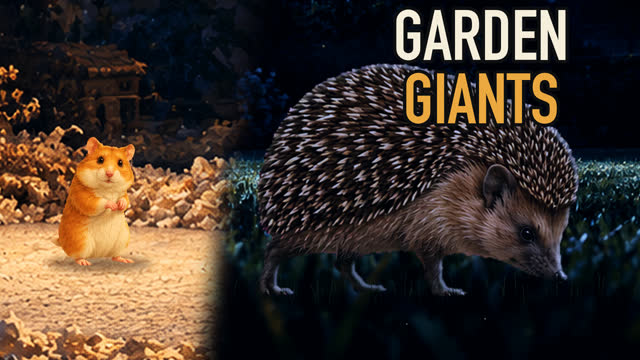
Backyard Giants · Episode 1 · 15:52. Long-form episode; the video player arrives at public launch.
What the episode is about
Pip, a golden hamster, watches the garden from his window while we drop down to his height: a moth trapped by a lamp, a bat that hunts with sound, a spider that builds its web by touch, and a hedgehog on her nightly rounds.
Key facts
- Lab golden hamsters are mostly active at night, while wild females in Syria were active almost only by day (Gattermann et al., 2008).
- A 2024 study looked at why insects get trapped around artificial lights.
- A small gap under a fence (about 13 cm, 5 in) works as a hedgehog highway.
Scenes are painted and dramatized from the sources below. Where accounts disagree, the episode says so.
More from Backyard Giants
Sources
- Lab golden hamsters >80% active at night; wild females in Syria active almost only by day; most lab and pet lines trace to a small colony founded in 1930 near Aleppo: Gattermann et al. (2008), Golden hamsters are nocturnal in captivity but
- Wild range (northern Syria, southern Turkey), farmland burrows, food stores: Gattermann et al. (2001), Notes on the current distribution and the ecology of wild golden hamsters, Journal of Zoology
- Wild golden hamster: Endangered (IUCN, since 2022); small range; persecuted as a pest: IUCN Red List, Mesocricetus auratus; IUCN 2022-2 category-change table
- Pet ancestry: Merck Veterinary Manual, Hamsters
- Local name roughly 'Mister Saddlebags': Smithsonian Magazine, The untold story of the hamster
- Cheek pouches reach the shoulders: Golden hamster (Wikipedia summary of the literature)
- Hamster hearing up to ~46 kHz (60 dB): Heffner et al. (2001), Audiograms of five species of rodents, Journal of Comparative Psychology
- Bats feeding around streetlamps (Sweden): Rydell (1992), Exploitation of insects around streetlamps by bats in Sweden, Functional Ecology 6: 744-750
- Hamster senses, teeth that keep growing, bedding and care basics: RSPCA, Hamsters
- Why insects circle lamps (dorsal light response, 3-D flight tracking): Fabian et al. (2024), Why flying insects gather at artificial light, Nature Communications 15: 689
- Streetlights cut nocturnal pollinator visits to flowers by ~62%: Knop et al. (2017), Artificial light at night as a new threat to pollination, Nature 548: 206-209
- Elephant hawk-moth: hovering, coiled proboscis, trunk-like caterpillar with eye spots: The Wildlife Trusts, Elephant hawk-moth
- Colour vision in starlight (Deilephila elpenor): Kelber, Balkenius & Warrant (2002), Scotopic colour vision in nocturnal hawkmoths, Nature 419: 922-925
- ~160,000 moth species vs ~17,500 butterfly species: Smithsonian BugInfo, Moths
- Common pipistrelle: size, ultrasound calls (~45-70 kHz, loudest ~45 kHz), up to ~3,000 insects a night (upper estimate), roosts in buildings: Bat Conservation Trust, Common pipistrelle
- Moths with ears dive or loop away from bat-like ultrasound: Roeder (1962), The behaviour of free flying moths in the presence of artificial ultrasonic pulses, Animal Behaviour 10: 300-304
- Garden spider: white cross, silk hub, web built in ~30 min by touch, daily rebuild and silk recycling, life cycle: British Arachnological Society, Factsheet 4: Garden spider
- Orb-weaver legs resist their own glue: Briceño & Eberhard (2012), Spiders avoid sticking to their webs, Naturwissenschaften 99: 337-341
- Spider dragline silk strength and toughness: Gosline et al. (1999), The mechanical design of spider silks, Journal of Experimental Biology 202: 3295-3303
- Moth scales let moths escape orb webs: Eisner, Alsop & Ettershank (1964), Adhesiveness of spider silk, Science 146: 1058-1061
- Hedgehog highways (13 x 13 cm), 1-2 km a night, 5,000-7,000 spines, diet, hoglets, hibernation, badgers: Hedgehog Street (People's Trust for Endangered Species + British Hedgehog Preservation Society)
- Rolling up; self-anointing (function unknown): Hedgehog Street, grooming and self-anointing
- Urban vs rural hedgehogs in Britain: BHPS + PTES, The State of Britain's Hedgehogs 2022
- European hedgehog moved to Near Threatened (IUCN, October 2024); declines ~30%+ over 10 years in many areas; threats: WildCRU, University of Oxford: European hedgehog IUCN Red List status updated
This is general information, not veterinary advice. If anything about your pet's behavior or health worries you, ask your vet.