Episode
Why a Rabbit Fears the Sky: Hawks, Kestrels and Buzzards
How does a rabbit know a hawk is coming? Clover spends an afternoon on the lawn while the garden's birds of prey sweep overhead.
Updated
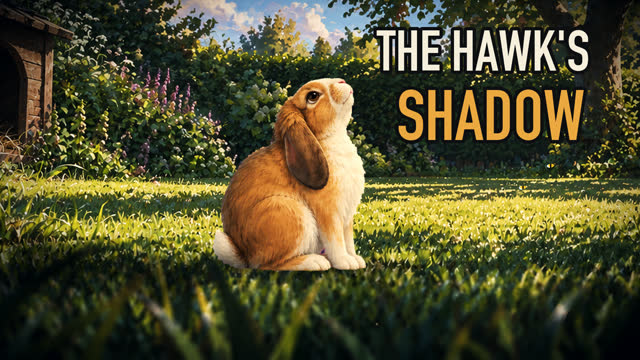
Backyard Giants · Episode 2 · 15:10. Long-form episode; the video player arrives at public launch.
What the episode is about
Clover, a lop rabbit, spends a supervised sunny afternoon on the lawn while birds of prey pass overhead: a sparrowhawk along the hedge, a kestrel hanging in the wind, a buzzard circling. At rabbit height we see the alarm calls, the freeze, the thump and the bolt-hole.
Key facts
- Domestic rabbits descend from the European rabbit, which is Endangered in its native range.
- A rabbit that freezes or thumps may feel threatened, unsettled or frustrated; context matters (RSPCA).
- Long-term studies in Britain have not found that sparrowhawks cause songbird declines.
Why does my pet...?
Scenes are painted and dramatized from the sources below. Where accounts disagree, the episode says so.
More from Backyard Giants
Sources
- Domestic rabbits descend from the European rabbit (Iberian origin); Endangered in its native range: IUCN Red List, Oryctolagus cuniculus
- Domestic rabbits are genetically linked to French wild populations; domestication was gradual and its date is uncertain: Carneiro et al. (2014), Science 345: 1074-1079; Oxford Archaeology, Rabbits: ecology, archaeologically speaking
- Vigilance in wild rabbits depends on social context (a nearby partner reduced it; extra unfamiliar rabbits raised it): Roberts (1988), Social influences on vigilance in rabbits, Animal Behaviour 36
- Rabbit senses, behaviour, thumping, binkies, housing and safety pointers: RSPCA, Rabbits
- Wild rabbits: warrens, activity, predators, appearance: The Mammal Society, European rabbit
- Sparrowhawk hunting, size, prey, success rate, pesticide crash and recovery, no songbird-decline evidence: BTO BirdFacts, Sparrowhawk; RSPB, Sparrowhawk
- Sparrowhawk (RSPB profile): RSPB, Sparrowhawk
- Alarm calls hard to locate vs mobbing calls easy to locate: Marler (1955), Characteristics of some animal calls, Nature 176: 6-8
- Many songbirds react to other species' alarm calls: Magrath et al. (2015), Eavesdropping on heterospecific alarm calls, Biological Reviews 90: 560-586
- Mice freeze or flee from an expanding overhead dark spot: Yilmaz & Meister (2013), Rapid innate defensive responses of mice to looming visual stimuli, Current Biology 23: 2011-2015
- Kestrel hovering, head stabilisation, diet: RSPB, Kestrel; Videler et al. (1983), Kestrel hovering, Journal of Experimental Biology
- Vole scent trails visible in ultraviolet to kestrels (1995 claim): Viitala et al. (1995), Attraction of kestrels to vole scent marks visible in ultraviolet light, Nature 373: 425-427
- Later work questioning kestrel UV vision: Lind et al. (2013), Ultraviolet sensitivity and colour vision in raptor foraging, Journal of Experimental Biology 216: 1819-1826
- Buzzard: soaring, mew, diet incl. rabbits, wingspan; recovery: RSPB, Buzzard; BTO BirdFacts, Buzzard
- Peregrine: stoop speed, nesting on buildings, pesticide recovery: RSPB, Peregrine
- North America: Cooper's hawk and red-tailed hawk: Cornell Lab of Ornithology, All About Birds
- Iberian lynx depends on rabbits: IUCN Red List, Lynx pardinus; LIFE Lynx
This is general information, not veterinary advice. If anything about your pet's behavior or health worries you, ask your vet.