Episode
Why Black Cats Got Blamed for Centuries: Myth vs Evidence
Where the black cat superstition came from: what the 1233 letter really says, the gene that makes a cat black, and where a black cat is a welcome sign.
Updated
Case Files · Episode 6 · 16:02. Long-form episode; watch the full video on YouTube below.
What the episode is about
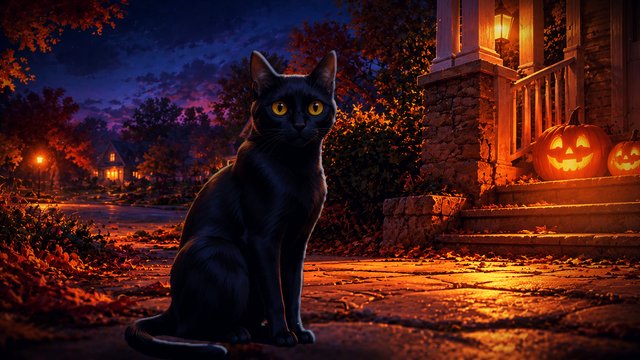
Your black cat's eyes shine from the dim hallway and somebody calls that a bad omen. Nori, the black cat next door, takes us through where the idea really came from: a letter from 1233 that never ordered anyone to harm a cat, the witch pamphlets and a Poe story that fixed the reputation, and the gene that makes a cat black in the first place. Then we follow the same black cat to places where it is a welcome sign: ships' cats in Britain, the Cat Sìth of Scotland, the kuroneko and maneki-neko of Japan. We end at the shelter, with what the evidence says about black cats waiting longer for a home.
Key facts
- Vox in Rama (1233) describes a black cat in an alleged heretical rite; its text contains no order to kill cats, and the "pope banned cats, so the plague spread" story has no support in the records (MGH text; Wikipedia overview).
- A black coat comes from two copies of the non-agouti ASIP variant, which hides the tabby pattern; faint "ghost stripes" can still show in strong light (UC Davis VGL; Cats Protection).
- Melanism arose independently several times across the cat family, including the black leopard, whose rosettes show up under infrared camera traps (Eizirik et al., 2003; Schneider et al., 2012; Hedges et al., 2015).
- Cats' eyes shine because a mirror-like layer behind the retina, the tapetum lucidum, bounces light back through the eye (Cornell Feline Health Center).
- In one UK charity's figures black cats took about a week longer to rehome; wider evidence is mixed, and photo lighting is one suggested reason (Cats Protection; Million Cat Challenge review).
- Slow blinking toward a cat makes it more likely to slow blink back and approach (Humphrey et al., 2020).
Why does my pet...?
Scenes are illustrated and dramatized from the sources below. Folklore is presented as folklore and marked as legend; the letter and newspaper pages on screen are our own recreations, not the real documents. No people are shown.
More from Case Files
- This Dog Waited at a Train Station for Almost 10 Years
- The Bird That Flew 7,000 Miles Without Landing
- The Dog Who Walked 2,500 Miles Home
Watch
 Watch on YouTube
Sources
- Gregory IX. (1233). Vox in Rama [Latin text]. In Monumenta Germaniae Historica, Epistolae saeculi XIII, vol. 1, pp. 432–434.
- Wikipedia. (n.d.). Vox in Rama [overview and context of the 1233 letter].
- Poe, E. A. (1843). The Black Cat. United States Saturday Post, August 19, 1843 [Edgar Allan Poe Society of Baltimore transcript].
- Jones, H. C., & Hart, C. L. (2020). Black cat bias: Prevalence and predictors. Psychological Reports, 123(4), 1198–1206.
- Eizirik, E., et al. (2003). Molecular genetics and evolution of melanism in the cat family. Current Biology, 13(5), 448–453.
- Schneider, A., et al. (2012). How the leopard hides its spots: ASIP mutations and melanism in wild cats. PLoS ONE, 7(12), e50386.
- Hedges, L., et al. (2015). Melanistic leopards reveal their spots: Infrared camera traps provide a population density estimate of leopards in Malaysia. Journal of Wildlife Management, 79(5), 846–853.
- UC Davis Veterinary Genetics Laboratory. (n.d.). Agouti (cat): The ASIP gene and non-agouti (solid) coat color.
- Cats Protection. (n.d.). Why are cats different colours?
- Cornell Feline Health Center. (n.d.). Feline vision problems: A host of possible causes [includes how the tapetum lucidum works].
- University of Missouri Extension. (n.d.). Cat project, Unit 3 [cat senses and night vision].
- Humphrey, T., Proops, L., Forman, J., Spooner, R., & McComb, K. (2020). The role of cat eye narrowing movements in cat–human communication. Scientific Reports, 10, 16503.
- Royal Museums Greenwich. (n.d.). Animals at sea [ships' cats in the Royal Navy and merchant fleets].
- Ministry of Defence. (2010, September). Desider, issue 28 [Royal Navy ships' animals, pets banned on ships from 1975].
- Folklore Scotland. (n.d.). Cat Sìth.
- Elgin Museum. (n.d.). Collections: The Kellas cat.
- nippon.com. (n.d.). Maneki-neko: Japan's beckoning cats [colours and paw meanings].
- Embassy of Japan in Singapore. (2022, January). Japan Creative Centre e-magazine: Neko [cats in Japanese culture].
- Yamato Transport. (n.d.). Why the black cat? [company symbol].
- Cats Protection. (n.d.). National Black Cat Day.
- Million Cat Challenge. (n.d.). Barriers to black cat adoption [review of the evidence].
- PAWS. (2024, September). The scary truth about black cat and dog adoption rates.
This is general information, not veterinary advice. If anything about your pet's behavior or health worries you, ask your vet.